.svg)


.svg)
alloClae vs Fat Transfer: A Physician's Honest Comparison
Both treatments restore lost volume using fat derived tissue. The real difference is where that tissue comes from, and what your body has to go through to get it. That single distinction drives almost every practical question patients ask us: whether surgery is involved, how long recovery takes, whether a lean patient even qualifies, and what happens to the volume over time.
Here is the honest comparison, including the cases where surgical fat transfer is the better answer.
Both treatments restore lost volume using fat derived tissue. Fat transfer harvests your own fat surgically, while alloClae is a ready to use 361 HCT/P adipose allograft placed during an office visit. Below is the side by side comparison, who each option genuinely suits, what changes after GLP-1 weight loss, and how to think about cost.

The short version
Fat transfer harvests your own fat through liposuction, which means an operating room and a second healing site.
alloClae is a 361 HCT/P structural adipose allograft that arrives ready to place, so there is no harvesting stage at all.
Lean patients who lack donor fat are often candidates for alloClae when they are not candidates for transfer.
A physician assessment determines which approach, if either, fits your anatomy and goals.
What Fat Transfer Involves
Fat transfer, formally autologous fat grafting, is a surgical procedure with three stages. Fat is harvested from your body through liposuction, typically from the abdomen, flanks, or thighs, then processed, purified, and injected into the area being treated. It has a long track record, and in the right hands it produces natural, lasting results.
.webp)
The trade-offs are structural to the procedure itself. It requires an operating room and anesthesia, and it creates a second surgical site, the donor area, which has its own recovery, swelling, and contour risk. Not all transferred fat survives either: a portion of the grafted cells are reabsorbed in the months after surgery, which is why surgeons often place more volume than the final result calls for, and why some patients need a second round.
What alloClae Is
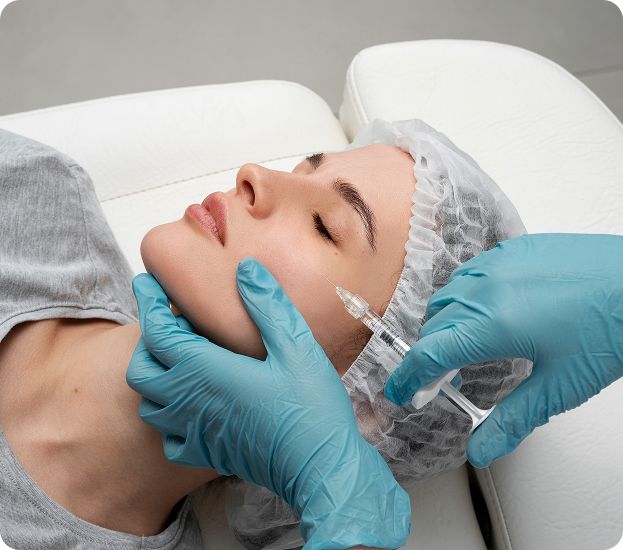
alloClae is a structural adipose allograft, a 361 HCT/P human tissue product made from donated, screened adipose tissue and placed through a thin cannula during an office visit. It is not a dermal filler and not a synthetic gel. For how it works in detail and which areas it treats, see our full alloClae guide linked below.
Comparison: alloClae vs Fat Transfer
| Feature | Fat Transfer | alloClae |
|---|---|---|
| Tissue source | Your own fat, harvested by liposuction | Donated, screened adipose allograft |
| Setting | Operating room with anesthesia | Office visit under local anesthetic |
| Donor site | Yes, with its own recovery and contour risk | None |
| Lean patients | Often not candidates, insufficient donor fat | Candidates, no donor fat required |
| Downtime | Days to weeks, two healing sites | Most patients resume normal activity quickly |
| Volume behavior | Partial reabsorption expected, often overcorrected | Placed volume integrates as the scaffold remodels |
| Best suited for | Larger volume change when donor fat is available | Targeted contour restoration, lean patients, non surgical preference |
.webp)
After GLP-1 Weight Loss, the Donor Fat Math Changes
Patients who have lost significant weight on GLP-1 medications such as semaglutide and tirzepatide ask this exact question more than anyone, and for them the comparison tilts sharply. Rapid fat loss removes the very donor fat a traditional transfer depends on, so the leaner the result, the less there is to harvest. alloClae requires no donor fat at all, which is often what makes it the only viable option of the two.
Who Suits Which
Fat transfer earns its place when the goal is a larger volume change, the patient has comfortable donor fat available, and surgery is acceptable or even preferred so everything happens in one operative session. alloClae suits a different profile: lean and athletic patients whose hip dips or contour irregularities persist precisely because they have so little fat, and patients whose priority is a specific area rather than wholesale augmentation.
No single treatment is right for every body. There are patients we assess for alloClae and advise toward surgical consultation instead. Body contour restoration rewards honest assessment more than almost anything, which is exactly why this decision belongs with a physician rather than a menu. At AlyneMD, candidacy, the areas addressed, and expected outcomes are established in person with Dr. Sandhu.
Explore the full treatment page: alloClae body contouring in Warren, NJ and New York, NY
Pair contour restoration with physician guided GLP-1 weight management at AlyneMD
Related reading: How alloClae full-body contouring works, a physician's guide
Cost: Compare the Whole Picture
Fat transfer pricing reflects surgery: operating room time, anesthesia, and surgeon fees, typically quoted as a single procedure cost. alloClae is priced by the volume placed and the areas treated, without facility and anesthesia fees. Which is more economical depends entirely on the scope of correction, which is why we treat cost as part of the candidacy conversation rather than a number on a menu.
Frequently Asked Questions
Frequently Asked Questions
HIGH VISUAL PERFORMANCE
Body contour concerns that diet and exercise can't address: hip dips, divots, contour irregularities, and small asymmetries, by regeneratively restoring volume where it's missing.
Hip dips are largely determined by skeletal structure and how soft tissue attaches, which is why they persist even in lean, fit people. Because the issue is missing volume rather than excess fat, restoring contour not losing weight is what addresses them.
Because the restored contour is your own regenerated tissue, results can be long-lasting, though this varies by area and individual. Your physician will set realistic expectations during your consultation.
Through an in-person assessment. Not every contour concern can be treated the same way, and a physician will tell you honestly what regenerative contouring can realistically improve for you.
Find out what regenerative body contouring can do for you.
Book a physician-led consultation at AlyneMD call (908) 888-9199 or request your appointment online.


.webp)

.webp)


.png)


.png)
.webp)
.png)




.svg)