.svg)


Physician-led blood filtration therapies supporting immune balance, inflammation reduction, and metabolic health.
*THIS Inuspheresis TECHNOLOGY IS NOT AVAILABLE IN THE CLINIC CURRENTLY AS IT IS UNDER FDA REVIEW IN THE UNITED STATES . FOR EDUCATION ONLY.
A Scientific, Targeted Approach to Blood Filtration
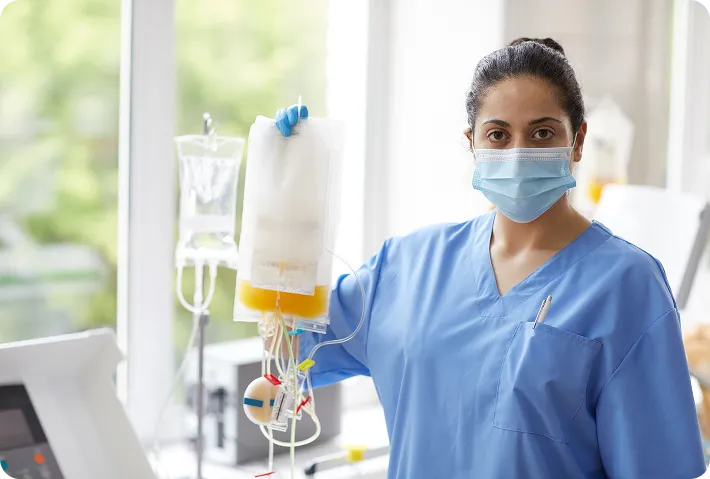
At AlyneMD, we use evidence-based blood filtration therapies to support patients dealing with inflammation-driven aging, autoimmune tendencies, cardiovascular risks, & metabolic issues.
Instead of generic “detox” methods, our approach focuses on clinically supervised, targeted removal of inflammatory molecules, immune complexes, lipoproteins, and oxidative byproducts.
We offer a tiered system including Inuspheresis, EBOO, and Therapeutic Plasma Exchange, with each therapy serving its own purpose in longevity and regenerative medicine.
Inuspheresis:
Selective Immune &Inflammatory Filtration
Inuspheresis is our most advanced and targeted filtration method. Your plasma is passed through specialized medical adsorption columns that selectively remove autoantibodies, immune complexes, inflammatory cytokines such as IL-6 and TNF-α, Lp(a), and oxidized LDL particles. This therapy is non-destructive, preserves beneficial plasma components, and offers one of the strongest safety and evidence profiles in modern longevity medicine.
.webp)

Inuspheresis — Key Benefits
Inuspheresis supports immune and vascular health by selectively removing harmful circulating factors while preserving healthy plasma components.
.webp)
Treatment Highlights and What to Expect

on clinical goals


.svg)
.svg)

clinical team
See the Benefits in Action
Lp(a) Improvement
Inflammatory Markers
Symptom Progress
What to Expect From Your Treatment Journey
Pre-Treatment
Post-Treatment
EBOO, INUSpheresis, and Therapeutic Plasma Exchange: How They Differ
These three therapies are often grouped together because they all circulate blood through an external device. What they actually do is very different. One adds something to the blood, one selectively filters it, and one replaces it. The right choice depends on what your labs show, what you are trying to accomplish, and your medical history. Dr. Sandhu determines candidacy for each protocol individually, and some treatment plans use more than one in sequence.
| EBOO | INUSpheresis | Plasma Exchange (TPE) | |
|---|---|---|---|
| What it is | Extracorporeal blood oxygenation and ozonation | Double filtration plasmapheresis, also called cascade filtration | Full plasma removal and replacement |
| Core action | Adds. Blood passes a gas exchange filter where it meets a medical oxygen and ozone mixture, then returns to you | Filters. Plasma is separated from your cells, passed through a second size selective filter, and your own plasma is returned | Replaces. Your plasma is removed and substituted with albumin, donor plasma, or a combination |
| What it addresses | Oxidative signaling and microcirculation. The circuit filter also captures some lipid and particulate debris | Larger circulating molecules including inflammatory cytokines, immune complexes, autoantibodies, oxidized lipids, and fibrinogen | Plasma broadly, including pathogenic antibodies, along with beneficial components such as clotting factors and immunoglobulins |
| Selectivity | Not a removal therapy. Primary effect is oxidative signaling | Selective. Sieves by molecular size and retains albumin and smaller beneficial proteins | Non selective. Removes plasma without distinguishing helpful from harmful |
| Replacement fluid | None | Usually none. Your own filtered plasma is returned | Required. Albumin and or donor plasma |
| Typical session | About 45 to 60 minutes | About 2 to 3 hours | About 2 to 4 hours |
| Access | Two IV sites, typically one per arm | Two IV sites | Two large bore IV sites, or central access in some cases |
| Typical course | Usually a series, spaced per physician plan | Often an initial session or two, then reassessment with labs | A defined series determined by indication |
| Often chosen for | Oxidative stress, inflammation, circulation, energy and recovery goals | A measurable inflammatory or environmental burden identified on testing | Established autoimmune and neurologic indications |
| Status to understand | Ozone therapy is not FDA approved for the treatment of disease in the United States and is offered at physician discretion | Not FDA cleared for use in the United States. Established in European clinical practice, where published studies to date are limited in number and largely observational | The most established of the three, recognized in American Society for Apheresis guidelines for specific conditions |
The short version
EBOO is the shortest and lightest touch, focused on oxidative and circulatory support rather than removal. INUSpheresis is the selective one, built to take out specific large molecules while giving your own plasma back. TPE is the most established and the most aggressive, removing plasma wholesale and replacing it, which is why it is reserved for defined medical indications and requires replacement fluid.
None of these is a better therapy in the abstract. They answer different questions. Your candidacy assessment starts with what your testing shows, not with the technology.
Read more about EBOO therapy at AlyneMDWhat the evidence shows
It helps to separate the technique from the specific system. Double filtration plasmapheresis, the method INUSpheresis uses, was introduced in the early 1980s and has been used since then in immune mediated, hematological, and neurological conditions. The mechanism is well characterized and the technique itself is long established.
The published work on the INUSpheresis system specifically is more recent and much smaller in scale. It consists largely of retrospective series and case reports rather than randomized controlled trials. Two recent European analyses examined how efficiently the system separates plasma and which circulating substances it captures, across a few dozen procedures in small patient groups.
We tell you this because it is the honest picture, and because it is the kind of detail that should inform your decision rather than sit in a footnote. Dr. Sandhu will tell you directly whether your testing supports treatment, or whether it does not. Read our physician review of INUSpheresis evidence and U.S. availability →
Selected references: Castillo-Aleman et al., Journal of Clinical Apheresis, 2025. Castillo-Aleman et al., Therapeutic Apheresis and Dialysis, 2026. Double filtration plasmapheresis was first described by Agishi et al. in the early 1980s.
Why Choose AlyneMD
Frequently Asked Questions
Inuspheresis is a medical procedure using targeted adsorption columns. We don’t use “detox” terminology because it is not medically precise.
Yes. All therapies are performed with physician supervision and medical-grade monitoring.
We begin with a Longevity Diagnostic Consultation to determine whether Inuspheresis, EBOO, or plasma exchange is the right fit.
Session count varies based on your goals and medical profile.
Yes—many patients combine these therapies with peptide and metabolic protocols.
Plasma exchange is offered selectively and may be completed at a partner facility when advanced monitoring is needed.
EBOO exposes your blood to a medical oxygen and ozone mixture to support oxidative signaling and microcirculation, and takes about 45 to 60 minutes. INUSpheresis is a filtration therapy that separates your plasma and passes it through a size selective filter to remove larger molecules such as inflammatory cytokines and oxidized lipids, then returns your own plasma. It takes about 2 to 3 hours. EBOO adds. INUSpheresis removes.
No. Therapeutic plasma exchange removes your plasma entirely and replaces it with albumin or donor plasma. INUSpheresis filters your plasma and gives it back, so replacement fluid is usually not needed. That difference is why the two have different risk profiles and different indications.
Candidacy is determined by testing, not preference. Dr. Sandhu reviews your labs, history, and goals during your Personal Discovery Session and recommends a protocol, or advises against treatment if you are not a candidate. Some plans combine therapies in sequence.
AlyneMD performs INUSpheresis at our Warren, New Jersey clinic, under an hour from Manhattan. Consultations are available by appointment at our New York, NY location, with treatment performed in Warren. Patients travel to us from across the tri state area and from out of state. Call 908-888-9199.

.svg)